Pine Forest

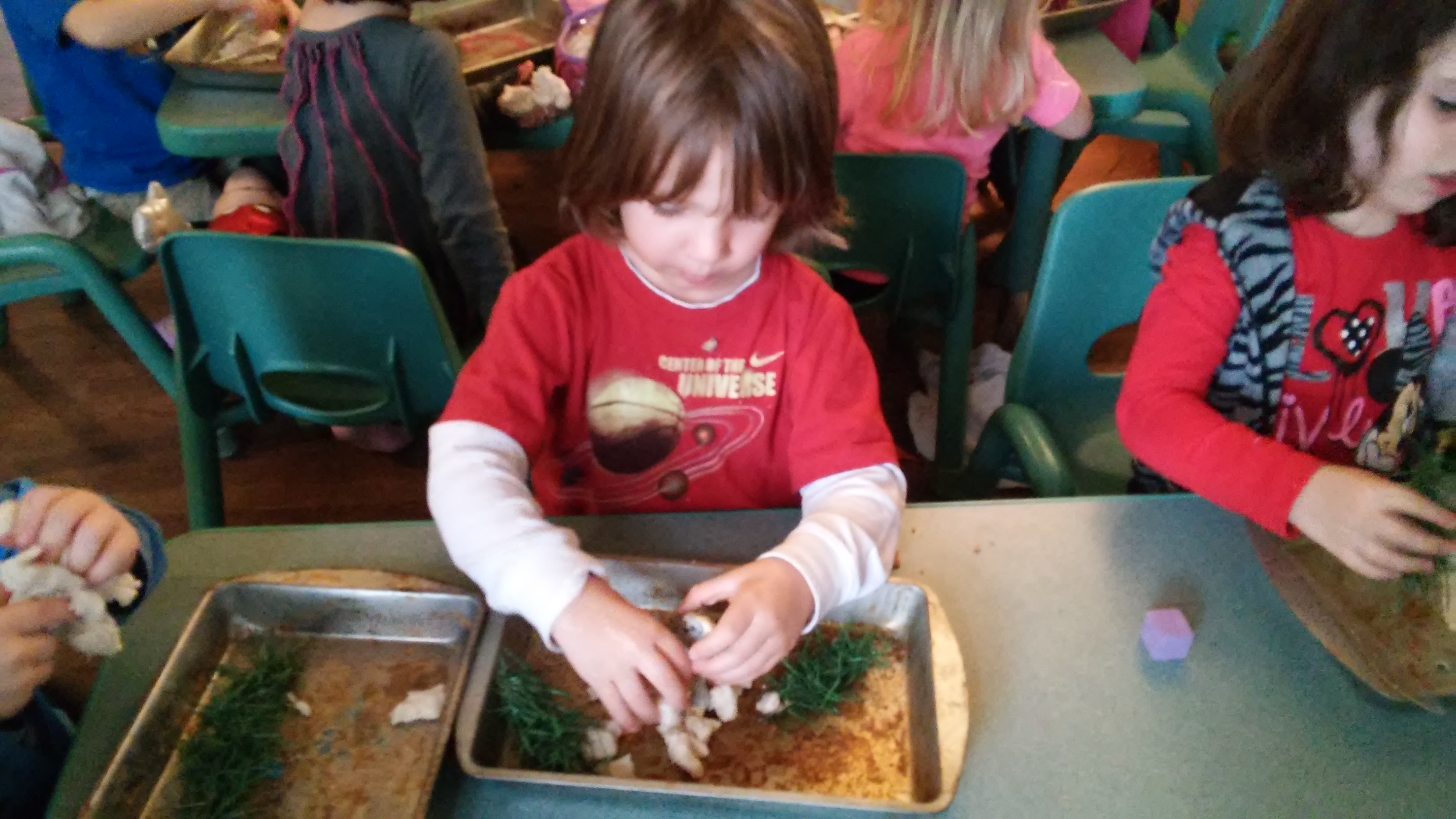
When children create an artificial environment, they bring three-dimensional reality to any concept.

20141216_153701

20141216_153633

Though your little ones are aware of what a Christmas tree is, they may not fully comprehend the trip it took for it to become one.

20141216_153744

20141216_153636

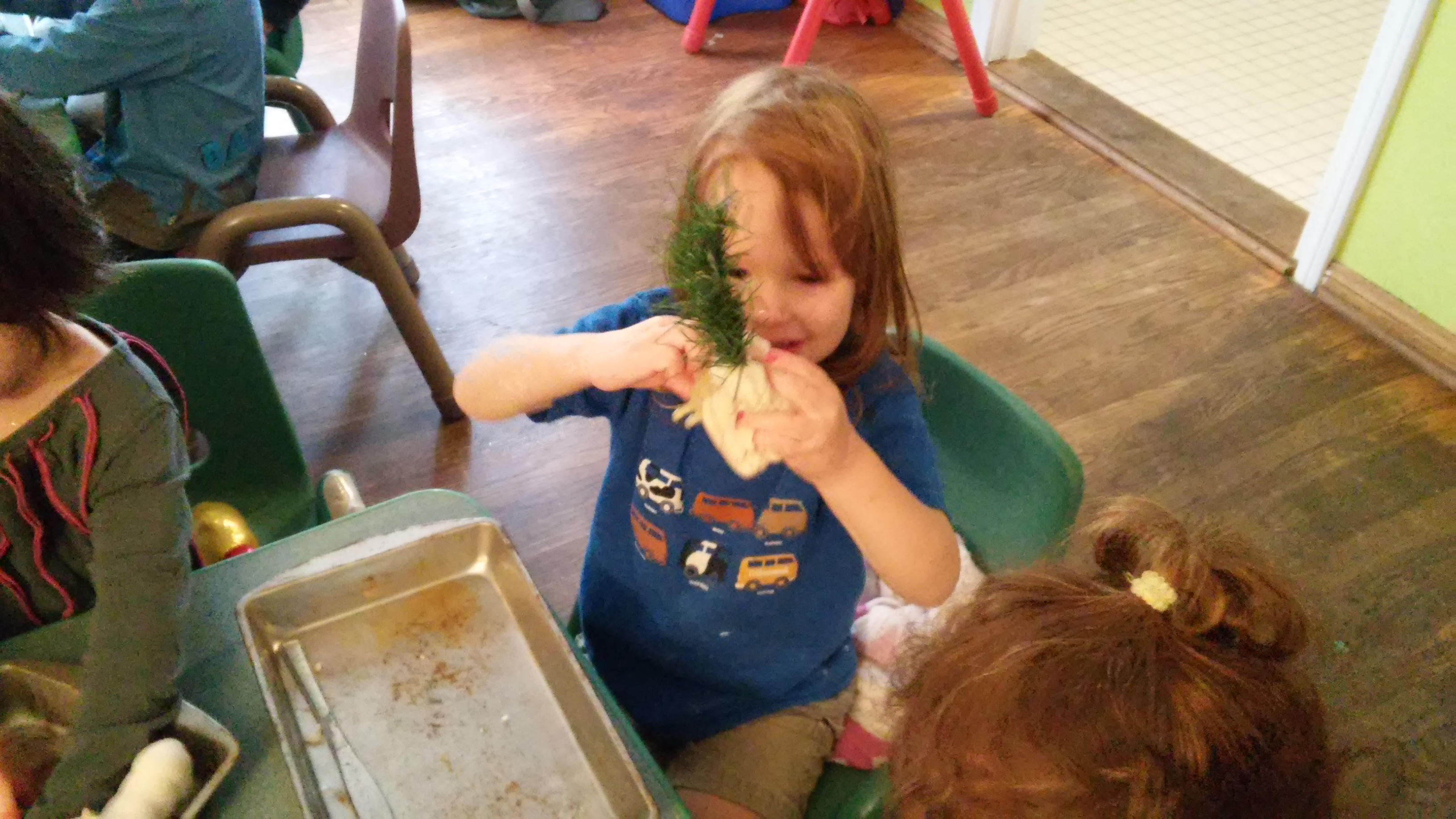
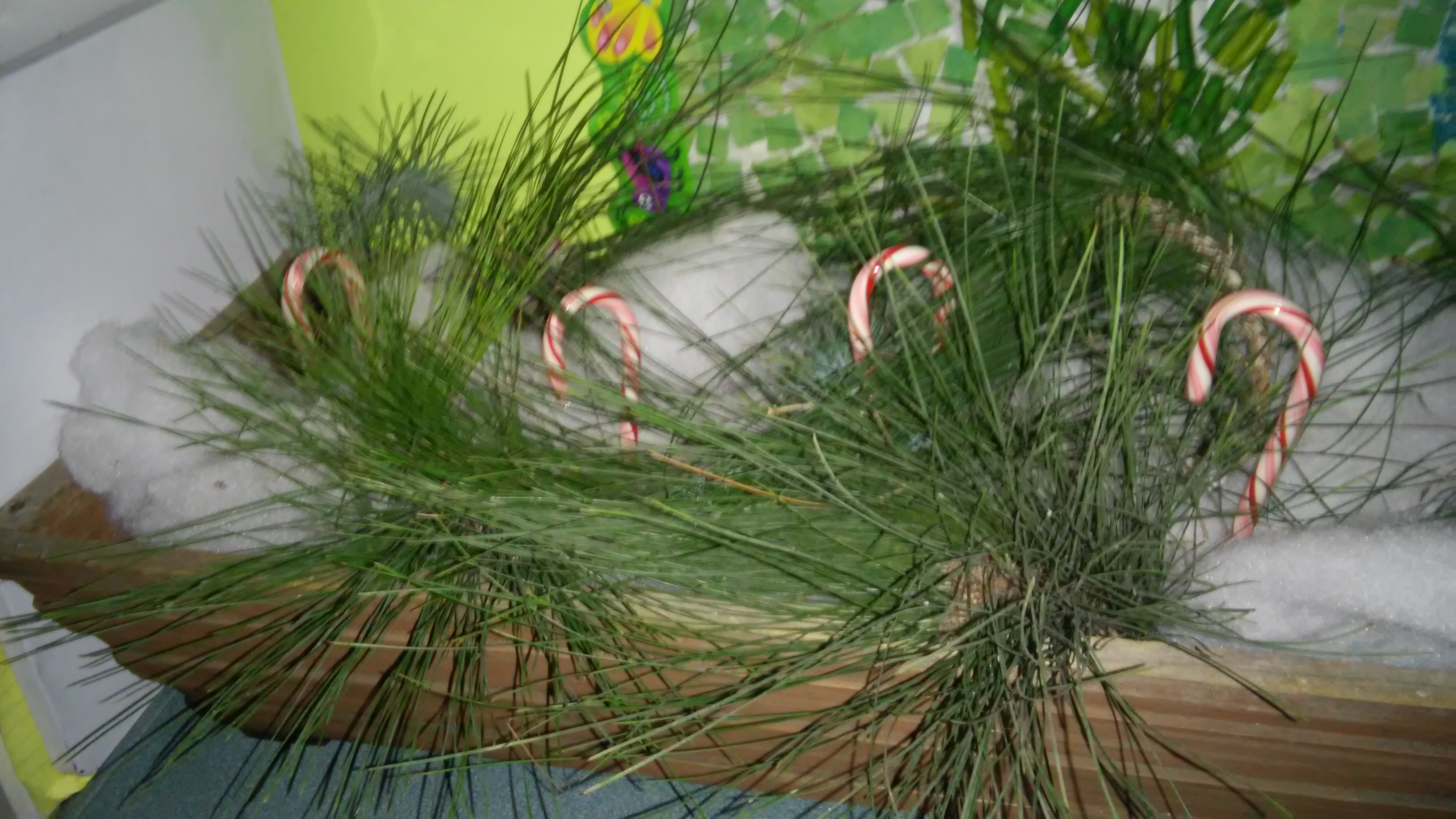
To help our budding arborists connect to this idea, we decided to create our very own pine forest!

20141216_170811

20141216_153730

This activity enabled students to not only learn about a foreign ecosystem, but additionally honed their academic skills and nurtured their innate curiosity and creativity.

20141216_124307

20141216_124249

The components of this project included white dough, artificial and organic pine boughs, styrofoam, and candy canes.

Christmas Tree Cones

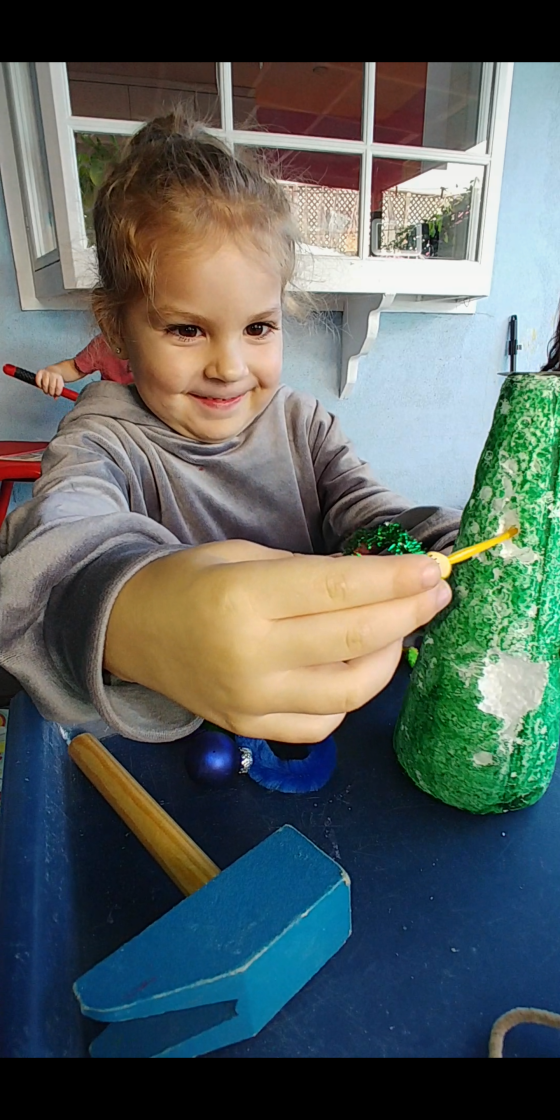
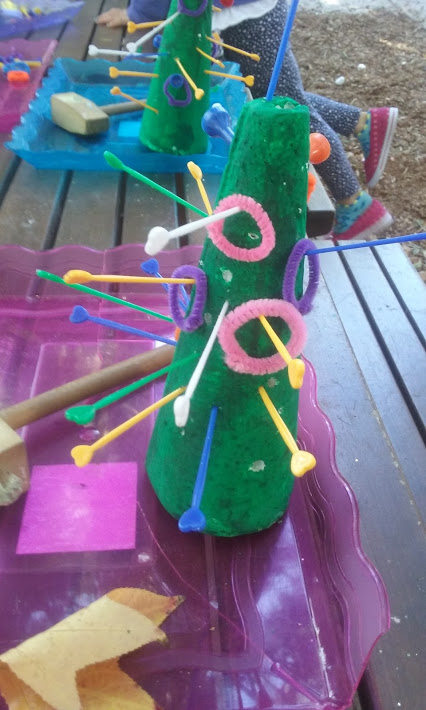
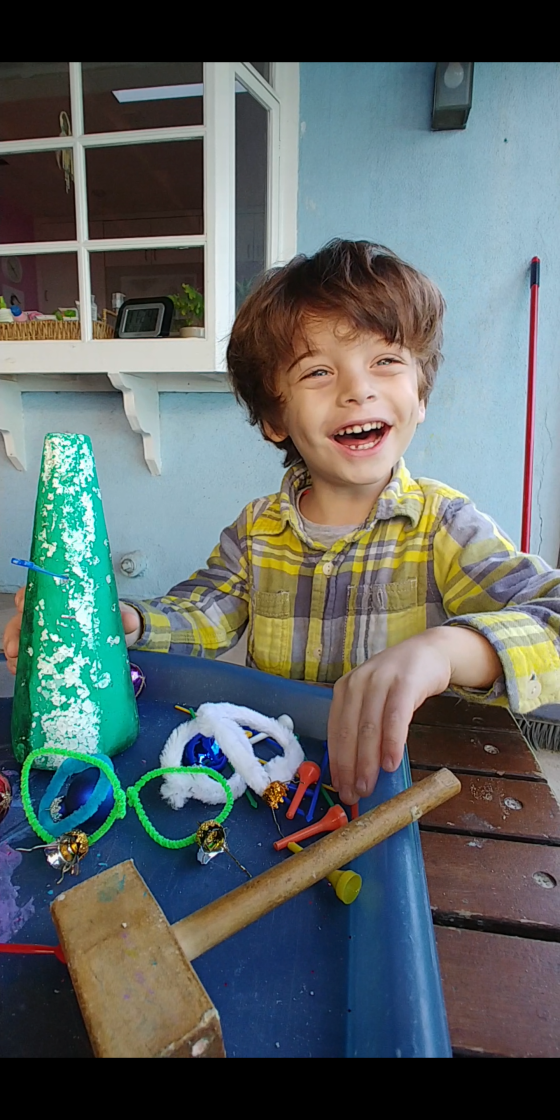
Using styrofoam cones, your little one decorated and painted their own little holiday trees!
Screenshot_2019-02-03-12-28-50.png
Your little ones first learned about the shape of a cone, and how it is similar and different from that of a triangle.
ham5
The next phase of the activity included painting the cone and adorning it with plastic golf tees and lacing these “tees” with small ornaments. This activity incorporated several developmental domains.
Treemotor1
Learning about new shapes fosters spatial recognition, encourages mathematical reasoning, increases vocabulary, and helps young children make connections to the world around them.
Treemotor2
Puncturing the cones with the golf tees, and lacing the ornaments onto the tees provided your little one with ample attempts to strengthen their fine motor and pre-writing skills.

Screenshot_2019-02-03-12-29-26.png

The Legend of the Poinsettia

In addition to our regular Christmas activities, we also began to learn about the Legend of the Poinsettia, a Mexican legend depicting the adventures of Pepita and her brother Pablo.

20141217_094851 (1)

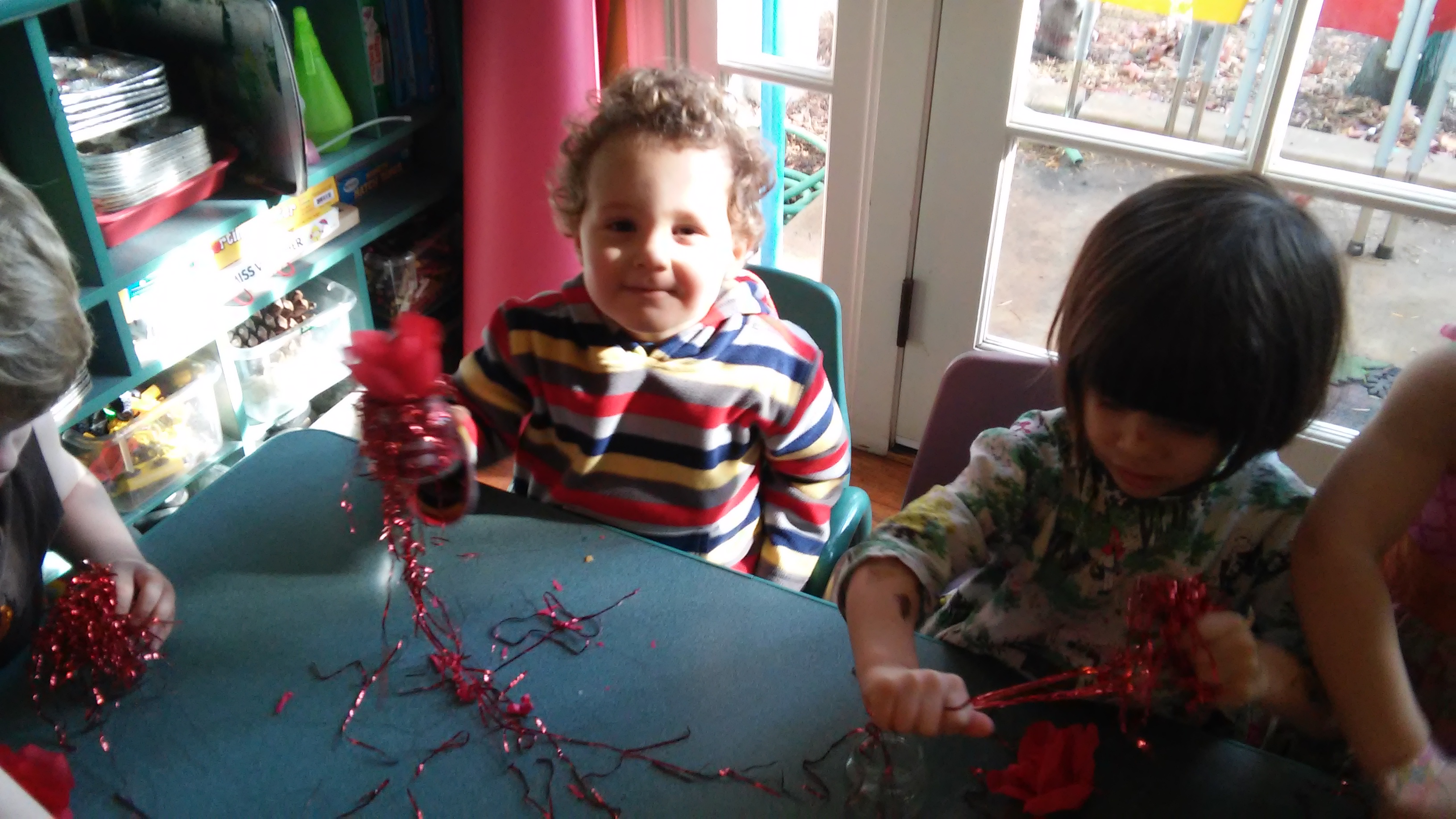
Using colorful illustrations, your children were told a preschool-friendly version of the legend, and then were given red tinsel, plastic poinsettias, and baby food jars to make there very own poinsettia plants!

20141217_094841

Young children are eager to learn about the world and they soak up the information like little sponges.

20141217_094853

In our classroom, children discover their relationship to other humans through stories, cultural celebrations, and the enriched cultural curriculum and materials. Diversity activities teach young children to respect and celebrate the differences in all people. Learning about different cultural aspects offers new experiences for children. This activity aimed to do just that.

20141217_094831

The German Christmas Tree

Long before the advent of Santa Claus and his elves, plants and trees that remained green all year had a special meaning for people in the winter.

German

Just as people today decorate their homes during the festive season with pine, spruce, and fir trees, ancient peoples hung evergreen boughs over their doors and windows.

German1

In many countries it was believed that evergreens would keep away witches, ghosts, evil spirits, and illness. But it is Germany that is credited with starting the Christmas tree tradition as we now know it.

German2

It all started in the 16th century, when the German people would bring decorated trees into their homes.

German3

Some built Christmas pyramids of wood and decorated them with evergreens and candles if wood was scarce.

German4

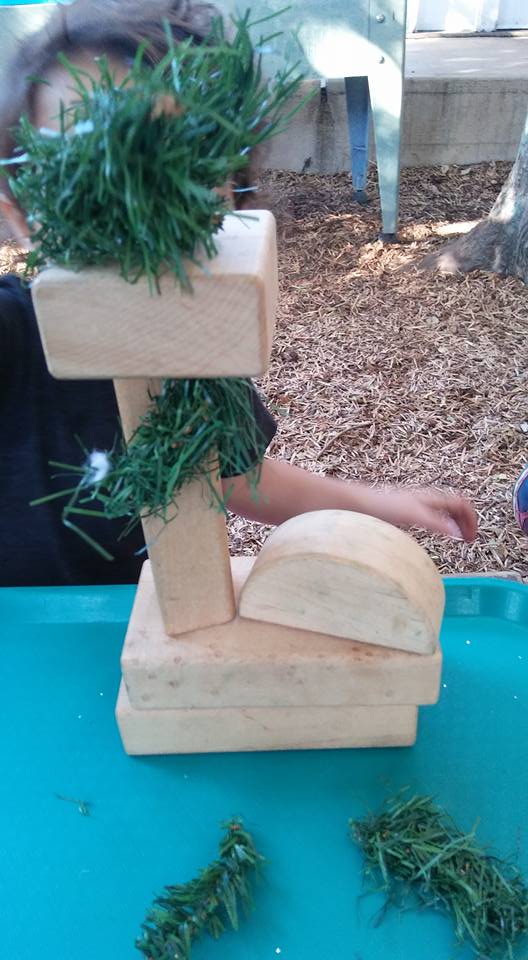
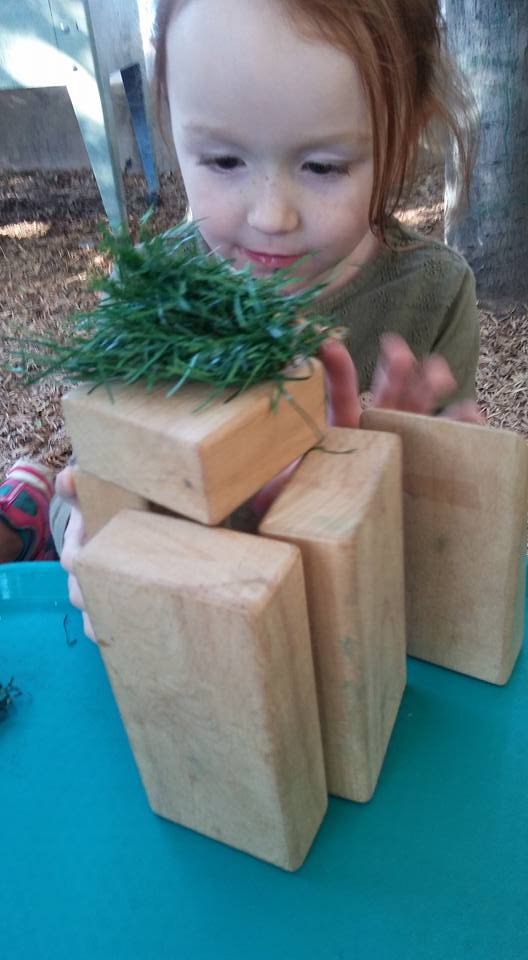
To recreate these early trees, we constructed our very own! Using blocks as our wood base and pine boughs, we formed our trees and then talked about them with our friends!

German5

Candy Cane Symmetry

When learning about symmetry, young children benefit most when they are introduced to new vocabulary with hands on activities. Because they think in three dimensions, an impasse arises through verbal instruction, unless they are granted hands on experiences at the same time.

candycane

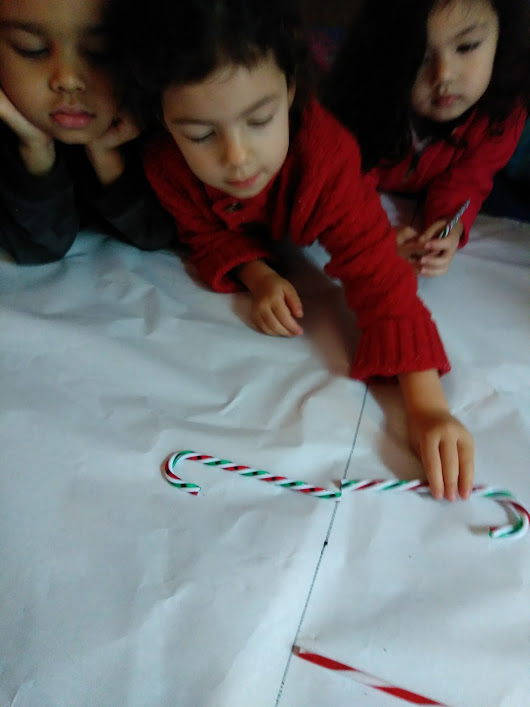
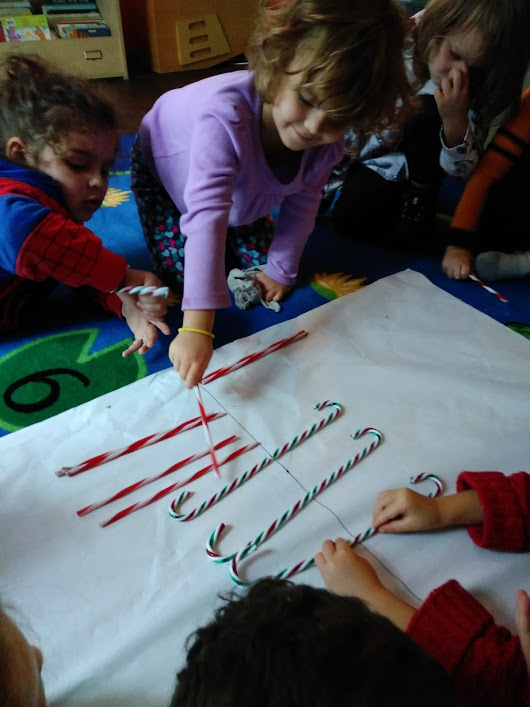
Young children will begin to understand the concepts and vocabulary of symmetry if you give them time to play symmetry games and experiment with symmetry art. For this activity, I placed a long piece of ribbon down the center of a piece of butcher paper, with a basket of candy canes to the side.

candycane2

Because this was our first time exploring symmetry, we paused a moment to talk about what symmetry is and identified some examples of symmetry in our classroom. We started this activity by taking turns placing the candy canes on the “board”. For the first round, your little one placed a candy cane on her side of the “game board”, and Miss Carrie placed a matching candy cane on her side. As we moved forward in the game, each child began to see how we were creating a symmetrical design (and everyone noticed when I intentionally placed my candy cane in the wrong spot!).

candcane2

Garland Discrimination

Although most children develop the ability to focus visually and to make fine discriminations in visual images as they grow, some children will take longer to develop these skills and may need some additional help, or additional practice. Good visual perception is an important skill, especially for school success.

20141215_101952

Children need good visual perception to discriminate well, copy text accurately, develop visual memory of things observed, develop good eye-hand coordination and integrate visual information while using other senses in order to perform tasks like recognizing the source of a sound, etc.

20141215_102209

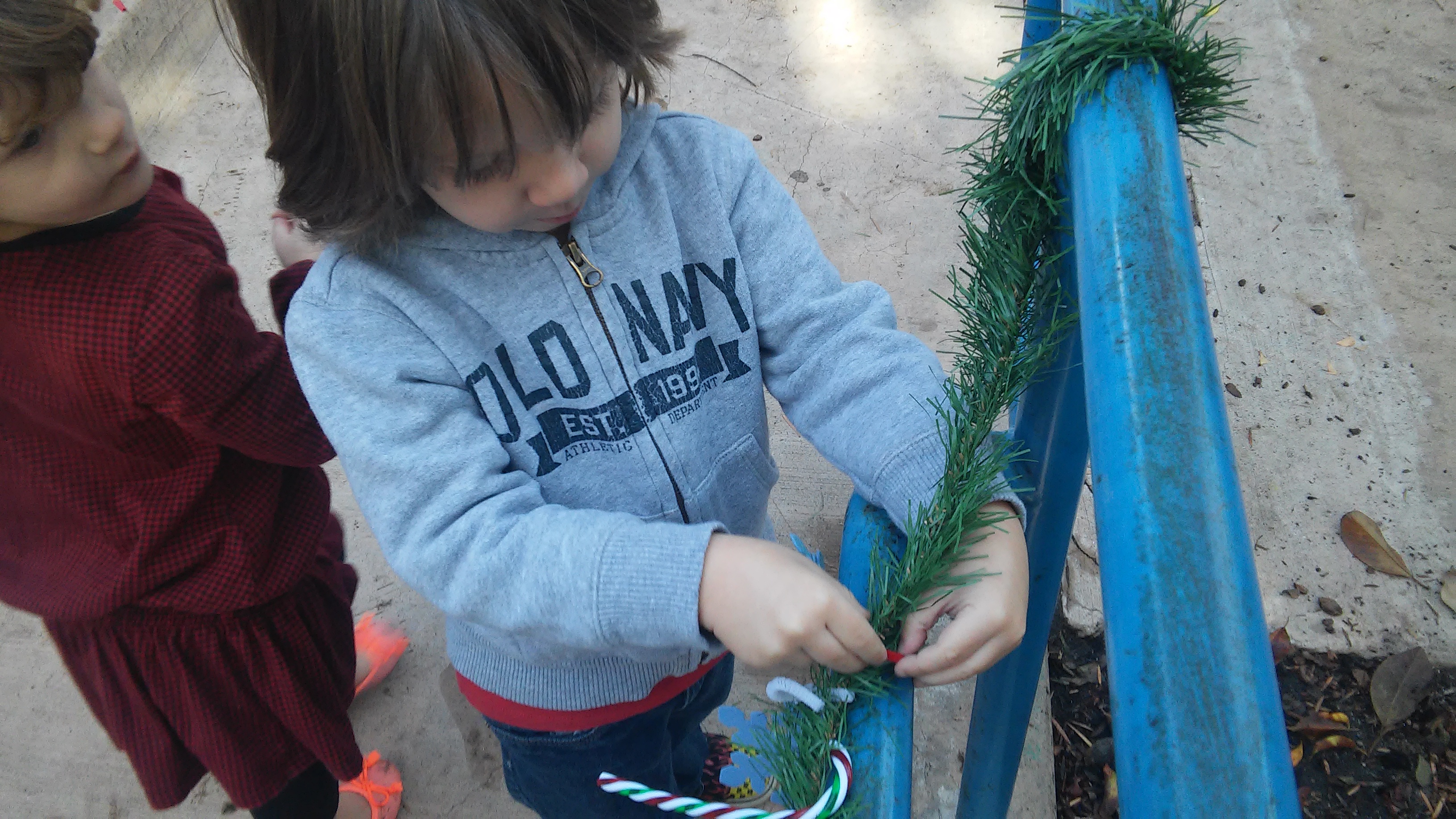
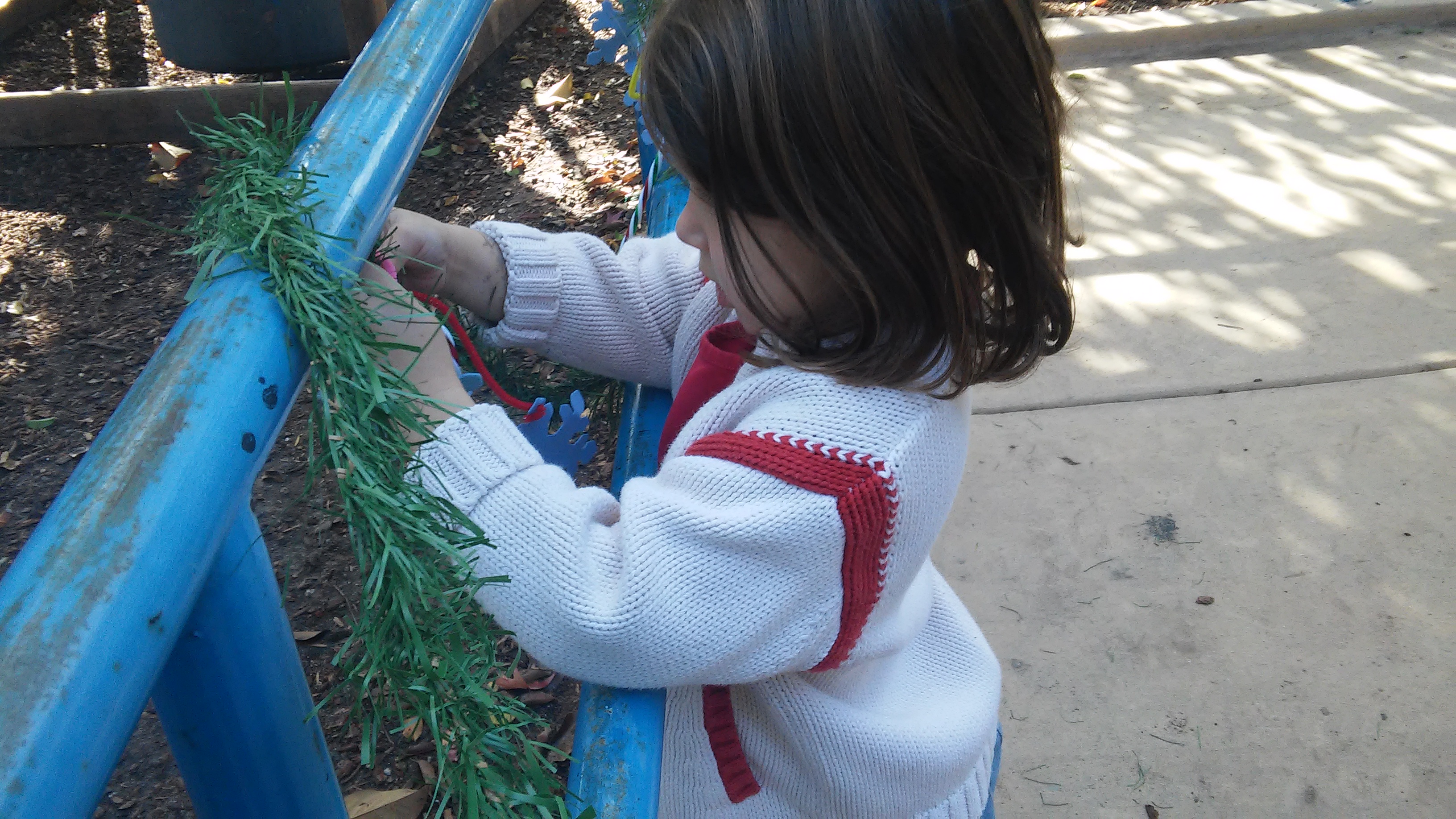
This activity accessed these pertinent skills. Using plastic candy canes and snowflake ornaments, your little ones weaved items into a plastic garland, which targeted their ability to perceive spatial relations.

20141215_102202

Doing so enhanced their visual memory and figure ground distinction. Visual memory was acquired, because, when placing each item into the garland, they were encouraged to recall and apply the spatial orientation of the item in correlation to the garland. Visual figure ground distinction was accessed because your little one focused on important impressions (e.g. the blue of the snowflake, the green of the candy cane) amidst many (e.g. the winding of the garland around the pole).

Candy Cane Science

During the holiday season, candy is prevalent in all aspects of the celebration.
20141217_105513
To capitalize on all of the sugar, we decided to conduct a science experiment! Using candy canes, M&Ms, and water, we observed the interaction between water and these sugary treats.
20141217_105505
This activity enabled your little one to explore concepts such as dissolving, the polarity of water (how it is a universal solvent), density, and the structure of candy.
20141217_110128
After the various candies were placed in water, they eventually dissolved.
20141217_110348
Young children are naturally curious.
20141217_110143
To help foster their understanding of how the world works, it is essential that they learn about the various materials in their lives, and the interactions between them. This activity also cultivated their observation skills.

Christmas Tree Shapes

When you look out your window, you may not be saying it, but your mind is noticing and identifying the green trees, brown rectangle buildings, square windows, and blue sky. Color and shape are ways children observe and categorize what they see. These very recognizable characteristics encourage children to define and organize the diverse world around them.

These first teachings in preschool and kindergarten are basics that your child needs to know before she learns the “other basics” of reading, writing, and math. Understanding color and shape is a tool for learning many skills in all curriculum areas, from math and science to language and reading. For example, when your child learns to discern the similarities and differences between colors and shapes, she is using the same skills she needs to recognize the differences between letters and numerals.

20141210_152529

We all use shape as a way of identifying and organizing visual information. Very early, your child begins to make a connection between familiar objects and their shapes. Changes in these can be surprising. For example, at first he may not want to eat round waffles or square cookies. But once he experiences this new shape information (and finds out it is still delicious!), he can easily integrate the new shape into his pantheon of shape knowledge.
20141210_153030

When your child explores different shapes, she is using one of the most basic educational processes: the observation of same and different. This concept provides her with a basic process that she will be able to use in observing, comparing and discussing all she sees and encounters.

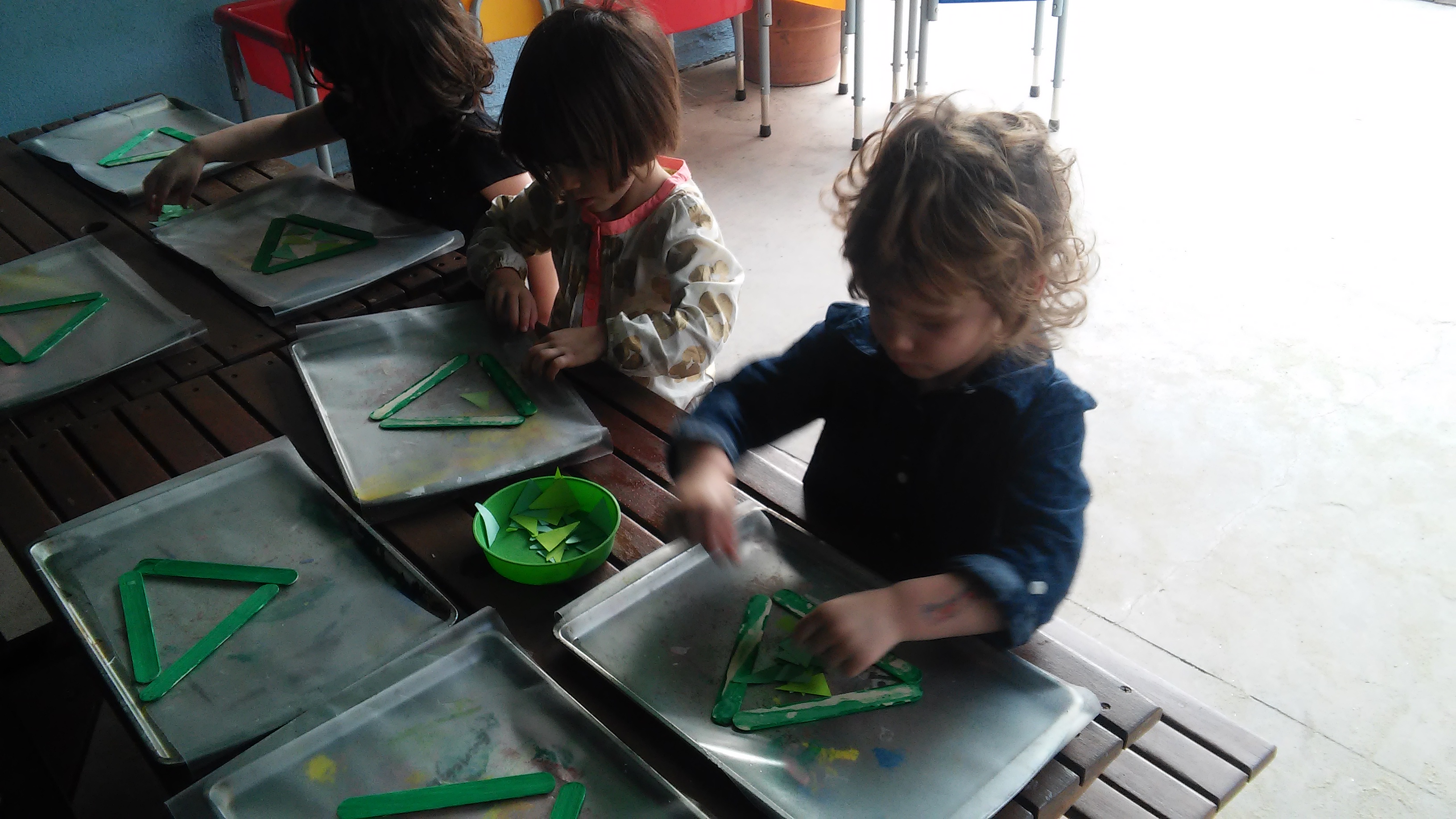
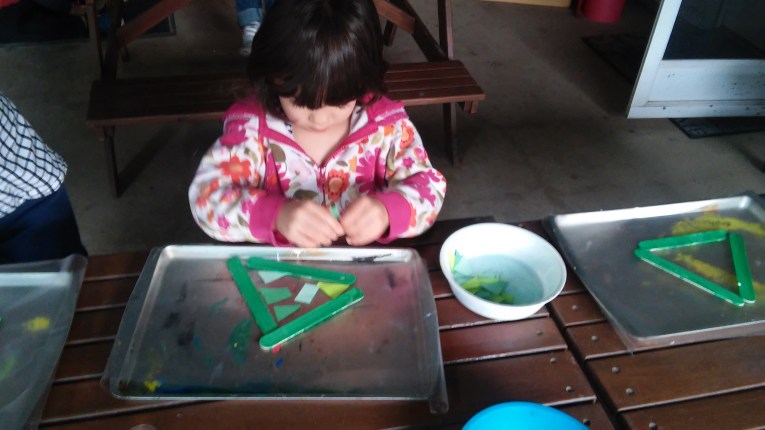
For this activity, we created Christmas trees using craft sticks, paper, and contact paper. Your child was directed to place pre-cut pieces of paper onto the contact paper, manipulating space to fill in and complete the triangle.

Christmas Tree Sewing

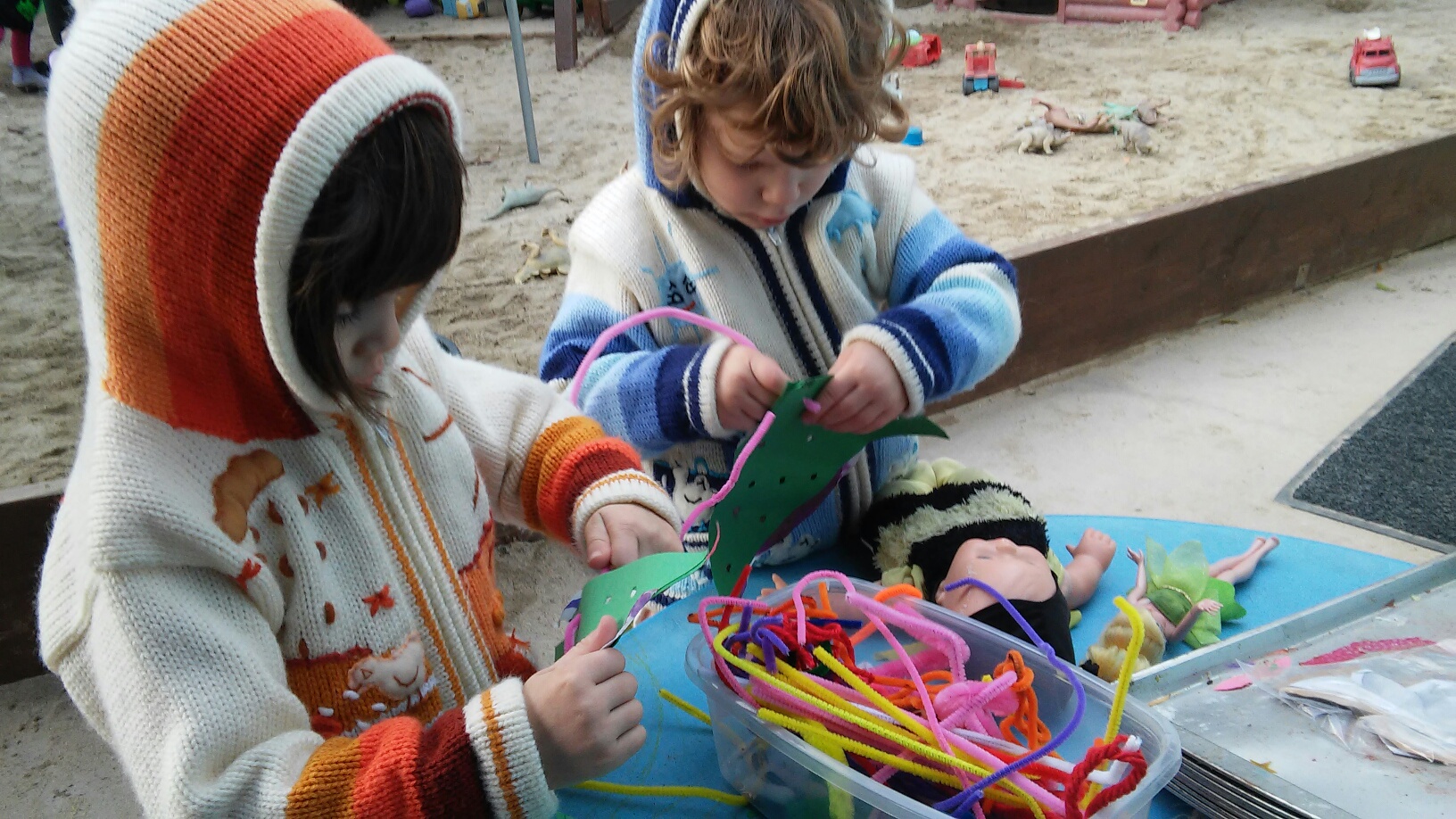
This activity involved lacing a pipe cleaner through a paper Christmas tree. Lacing (or sewing) activities are a great educational and developmental tool for preschoolers.
20141211_155010_resized

As children grasp the tip of the the pipe cleaner, they are building their pincer grip which is crucial for writing skills.  They also learn patterns and develop hand-eye coordination through the act of weaving the string through the holes.  Finally, it is also a lesson in patience as they ever so slowly work their way across the Christmas tree with their string.

20141211_155558_resized