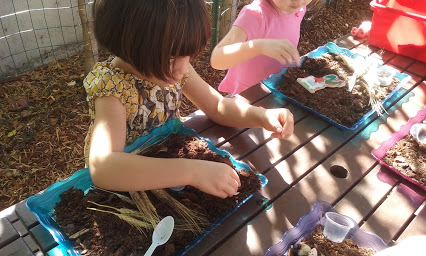
Counting Seeds

Of all the math skills that children will acquire, counting is one that most children will already be doing before they reach school-age.

seed count 4

seed count

Rote counting (or saying numbers in a sequence from memory) is what most children will be able to do, but this does not mean that they can actually determine the amount in a collection.

seed count 2

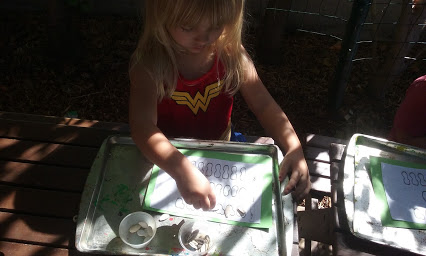
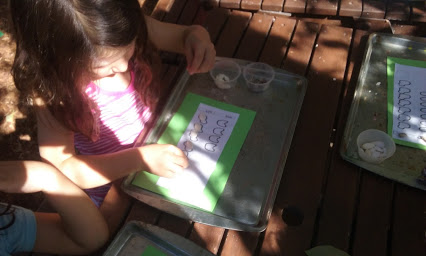
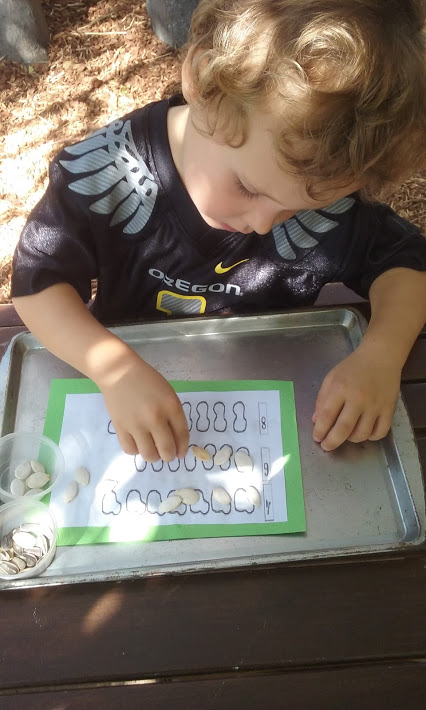
In order to help our students develop an actual understanding of numbers and how counting relates to real life, we did a hands-on activity with seeds aimed at developing their one-to-one correspondence.
seed count 3

By placing a certain amount of seeds on a diagram (counting as they did so), participants were able to make a connection between the spoken numeral and a concrete amount.
seed count 5

seed count 7

Beanstalk Weaving

Lacing and weaving activities provide a great educational and developmental experience for preschoolers.

stalk 1

As children grasp the tip of the item that they are lacing with, they are building their pincer grip which is crucial for writing skills.

stalk 2

They also learn patterns and develop hand-eye coordination through the very act of lacing or weaving.

stalk 3

Finally, it is also a lesson in patience as they ever so slowly work their way across the lacing base with their implement.

stalk 4

This activity involved a creative way to practice our lacing skills.

stalk 5

Using branches and toilet paper tubes, we created our own version of Jack’s beanstalk. We weaved the branches into the tubes, and saw our beanstalks come alive!

stalk 6

Jack and the Beanstalk Small World Play

Small world play occurs when children use miniature items such as toys, found objects, or replicas to act out scenes or ideas from real life, stories, or books.

jack 2

jack 1

Small worlds often include sensory elements which add even more depth to the experience and create more opportunities for language stimulation.

jack 3

jack 4

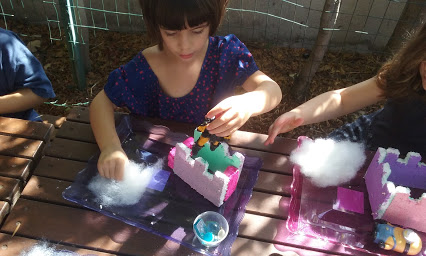
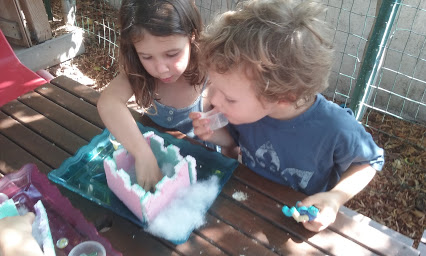
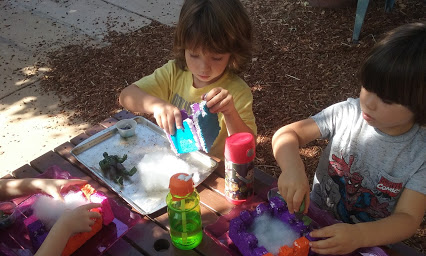
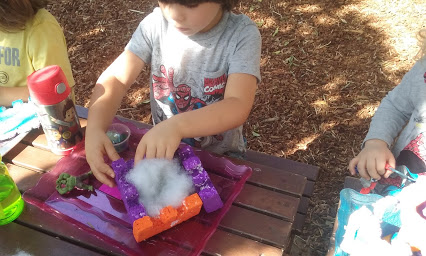
For this activity, we created castles out of styrofoam, and then used these castles to act out scenes from Jack and the Beanstalk.

jack 9

jack 5

Each castle came with jewels (to symbolize treasure), a plastic toy giant, a plastic toy Jack, and cotton to represent clouds. This activity was open-ended, which means that your little ones were given the freedom to explore and add their own twist to the plot of the story!

jack 7

jack 6

Play Dough Chicken Coops

With play dough, young children express their ideas through art and make-believe play.

chicken coop 7

chicken coop 6

At the same time, they learn symbolic thinking by pretending that the play dough is something else (“That thing with the antlers is a moose”).

chicken coop 5

chicken coop 4

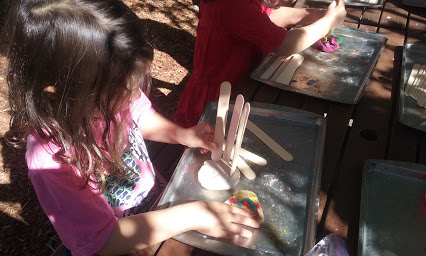
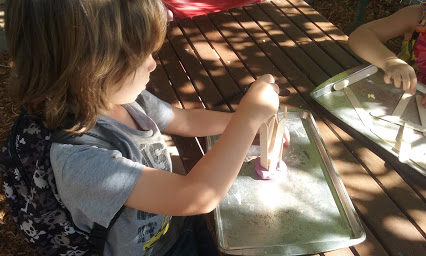
For this activity, we created chicken coops, using craft sticks and play dough.

chicken coop 3

chicken coop 2

This enabled your little one to connect with the main character of the Little Red Hen!

chicken coop

Planting and Harvesting Wheat – Small World Play

No Little Red Hen unit would be complete without a section on wheat! In the story, the red hen not only plants wheat, but harvests it and later turns it into bread!
red hen 1
red hen 2
This project involved your little one learning that wheat grows globally in bountiful supply.
red hen 3
They learned that because it can be harvested in winter and spring, it is utilized abundantly.
red hen 6
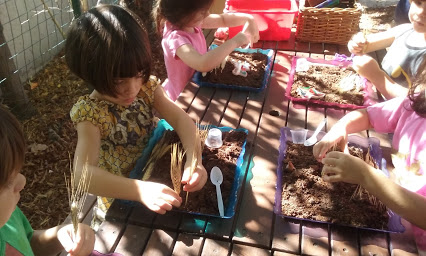
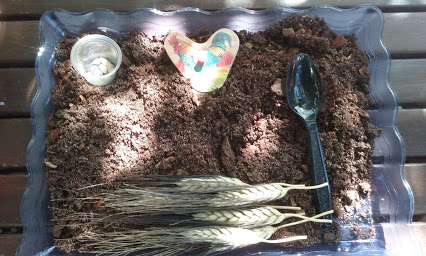
Using hens, stalks of wheat, seeds, and shovels, your little farmer harvested their own wheat…just like the little red hen!
red hen 7
They learned that these crops require constant care and upkeep.
red hen 8
Producing wheat is an intensive process, and your little one learned about the many technological advances that allow all of us to enjoy our bread, cereal, and pasta!
red hen 9
They were introduced to the words “swather” (to cut and bind wheat) and “combine” (a process in which trucks cut and loosen wheat from its stem).
red hen 10
By harvesting their own crops, your little one was able to apply their understanding of new vocabulary related to the Little Red Hen!
red hen 11