Moose Habitats

We began our Arctic Animal month with a lesson about all things related to the moose!!

moose

Although native to Europe and Asia, moose are found throughout Northern hemisphere in Northern Canada and other colder climates.
moose1

Moose are also called “elk” and are members of the deer family.

moose2

These large mammals are solitary and do not form herds. Although generally slow-moving and sedentary, moose can become aggressive and move quickly if angered or startled.

moose3

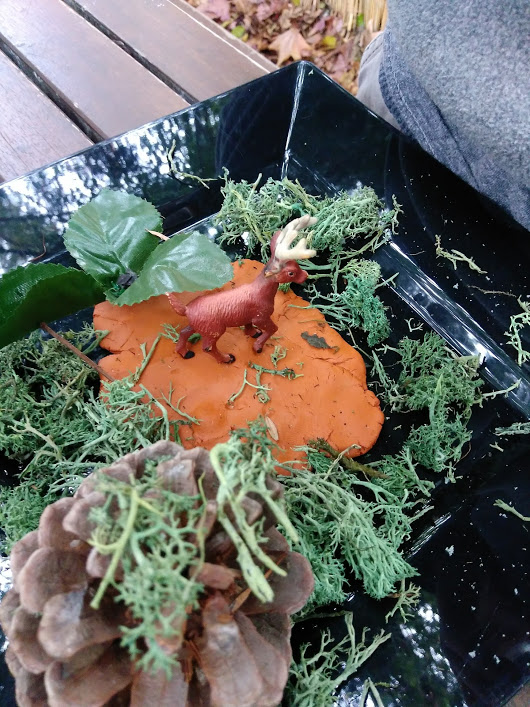
Using small toy moose, pine cones, artificial grass, rocks, and clay, we created our very own moose habitats!

Counting Clouds

Early math is not about the rote learning of discrete facts like how much 5 + 7 equals. Rather, it’s about children actively making sense of the world around them. Unlike drills or worksheets with one correct answer, open-ended, playful exploration encourages children to solve problems in real situations.

clouds3

Because the situations are meaningful, children can gain a deeper understanding of number, quantity, size, patterning, and data management.

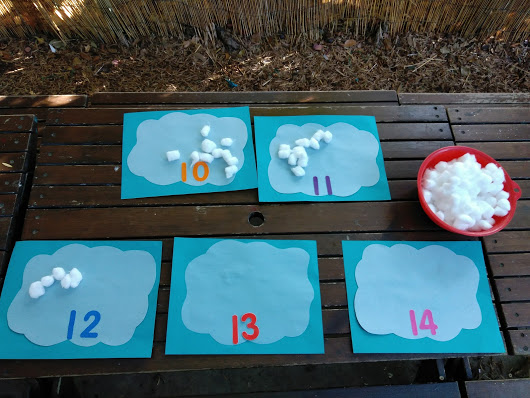
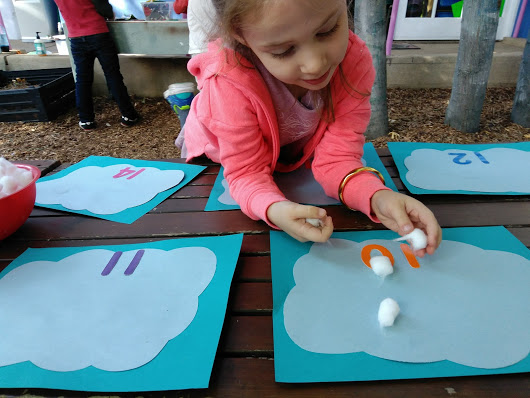
cloudsFor example, it is easier to understand what six means when applied to a real-life task such as finding six beads to string on a necklace or placing one cracker on each of six plates. It is for this reason that we cotton balls, colorful paper, and numbers to practice our counting. To fit this into our winter theme, we used colorful illustrations numbered 10-14.
clouds1

These symbolized clouds that your little ones made by sorting them by number. They started by placing them onto the clouds in no particular order. Once they mastered this task, they added them (while counting out loud) with the number ten on the top and the number fourteen on the bottom.  Next, they practiced adding and subtracting different cotton balls and counting them.

clouds2


Flower Foam Wreaths

Lateralization activities provide a great educational and developmental experience for preschoolers. As children grasp whatever implement they are working with, they are building their pincer grip which is crucial for writing skills.

wreath

The more they do this, the more they learn about which hand is more comfortable for them.

wreath3

Lateralization activities are also a lesson in patience as students ever so slowly work their way through a project  with their chosen implement.

wreath1

This activity involved a creative way to practice our lateralization skills. Using pine boughs and floral foam, your little ones wove their very own wreaths!

wreath2

Fall Leaf Sorting

Many preschoolers are able to use numbers arbitrarily; pretending to count, or mixing up numbers and letters. From about the age of four, preschoolers will begin to show one to one correspondence, or the ability to count objects correctly, as well as recognize most numbers 0-9 and sometimes recreate numerals when given an example.

leaves

As with many preschool skills, it is important for young students to be given many different opportunities for to see, touch and use numbers throughout the day. Including numbers in thematic play is one way that they can begin to recognize numbers.

leaves1

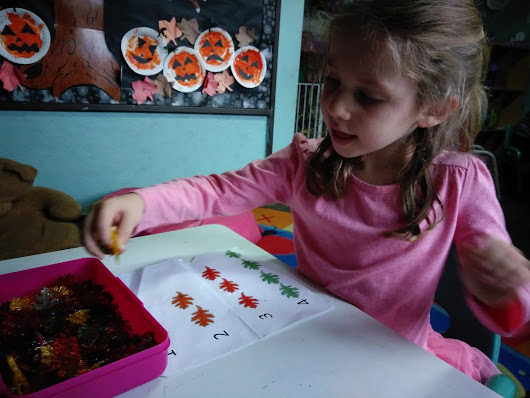
For this activity, your little one participated in a sorting/numeral recognition activity that tied in with our fall weather theme. Using manipulatives and pictures of leaves (with numbers printed on them), your little one practiced sorting and matching groups of leaves with their corresponding numeral.

leaves2

Lego Letters

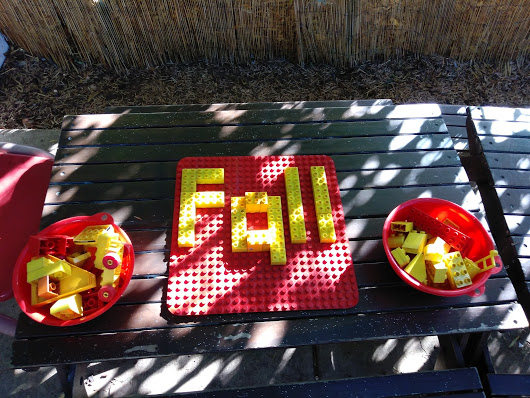
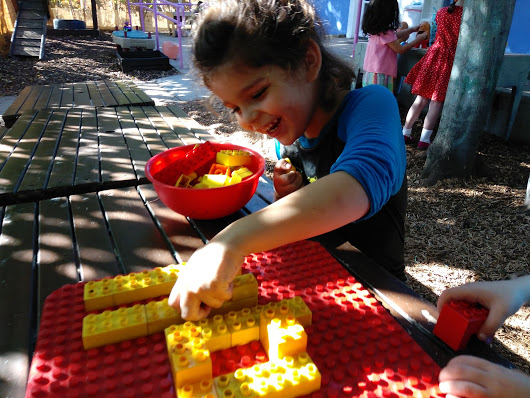
Using Legos, the letters F-A-L-L, and our learning minds, we created the word “FALL”! In young children, gross motor skills are the first to develop, therefore creating a need to continually introduce your budding writer to an array of fine motor activities. These activities build a foundation for the later manipulating of various writing utensils.

legoletter

Playing with Lego building blocks, cutting paper with scissors, and putting puzzles together all serve a developmental purpose. They not only promote coordination, but improve dexterity and hand control.

legoletter1

And not only that, when your children are moving, they are learning! In our classroom, we use games and other materials to relay prekindergarten concepts. These materials almost always consist of things that they are naturally interested in, so they do not realize they are learning!

legoletter2

Since our class is going through a Lego craze right now, we love to incorporate them into our developmental domains. By creating letters out of Legos, they are experiencing a range of important skills.

legoletter3

Cloudy Bones

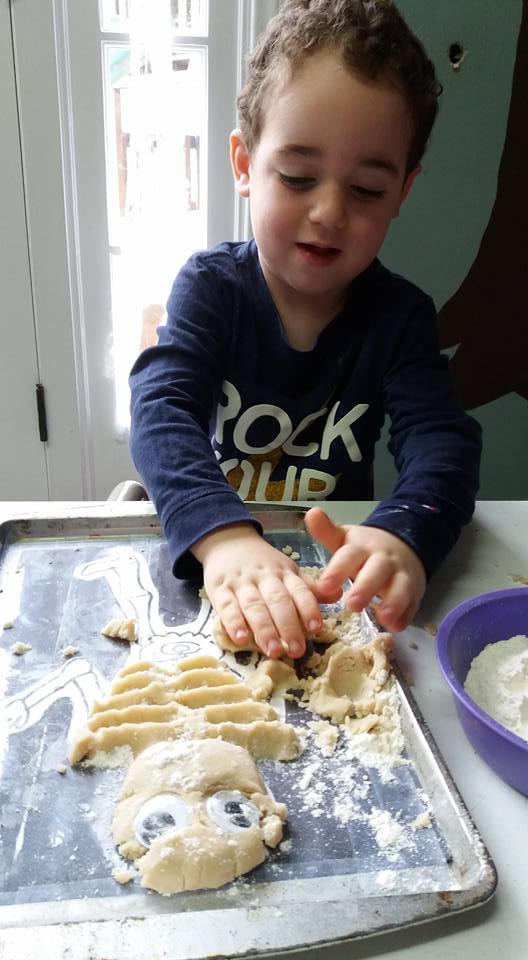
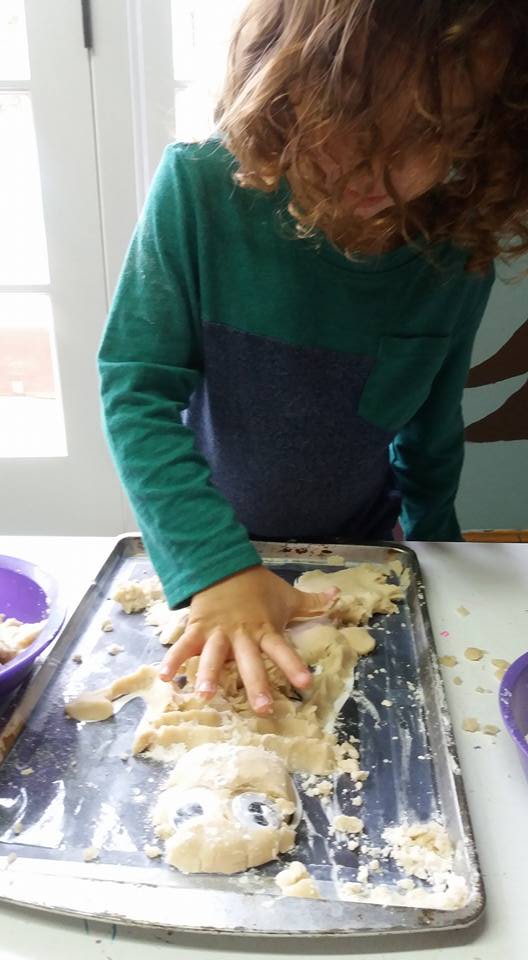
As part of simple, tactile play – cloud dough can be squashed, squeezed, rolled, flattened, chopped, cut, scored, raked, punctured, poked and shredded! Each one of these different actions aids fine motor development in a different way, not to mention hand-eye coordination and general concentration.

doughskel2

It is for these reasons that I use cloud dough so often, and for some many different learning experiences. Many young children are tactile learners and require the sense of touch to interact with the world around them. Because we are learning about all things related to skeletons, I combined cloud dough, a diagram of skeleton, and our thinking minds to learn more about anatomy!

doughskel1

There were two components of this activity. Students first named three different bones (the skull, ribs, sternum, and femur).   They then used their fingers to roll up cloud dough (baby oil and corn starch) into the different bones. Lastly (with help from Miss Carrie), they connected their pieces to create a full skeleton!

skel3

Feelings Pumpkins

Felt pieces are fun and inexpensive and allow children to practice creative and problem-solving skills. We try to use as many open-ended activities as possible, so your child is motivated to think divergently. Open-ended materials are those which young children can use for creative play in any way they like, within a set of guidelines for safety and clean up. Open-ended materials are like open-ended questions.

pumpface1

There is no “one” answer or one “right” way to use them. Any child can enjoy, and be successful in creating with a few simple materials, such as felt. Using open-ended materials nurtures both the child’s creativity and self esteem. Blocks, dress ups, props, recycled items, and natural materials like seeds, earth, sand, and water are also open ended materials which can be used in many ways. For this activity, we used felt pieces to create a variety of faces on felt pumpkins. There was no right or wrong answer. Each child created an expression that they saw fit, according to their own understanding of the various facial expressions they saw on a few pictures.

pumpface

Spider Web Weaving

To help us hone our fine motor skills, we strung pipe cleaners through an spider-shaped colander. Parents may think that activities like these have very little developmental significance, but the truth is just the opposite.

lace

Activities like these are crucial because they allow a break in the sometimes monotonous tasks of tracing or even coloring, and provides a wide range of motion that young writers can use. dominant hands. Stabilizing the cards while working the pipe cleaner through the holes strengthens those little fingers and muscles.

lace1